Tuesday, November 6, 2007

Monday, October 29, 2007
Assisted Living For Your Parents
By: Ron King
Over the past few decades, there have been some issues with nursing homes and because of this they do not have a very solid reputation. Many elderly people dread begin placed in a nursing home because they are familiar with the bad reputation. There are good nursing homes, but even if you find one, your loved one will still have some losses, such as their independence, privacy and personal freedom. If someone is elderly, but doesn't yet need constant medical care, it's important that you don't make the decision to send them to a nursing home prematurely. There are other options.
The alternative to a nursing home is an Assisted Living Facilities, popularly known as ALF. These facilities are for people needing assistance with Activities of Daily Living (ADLs), but who want to live as independently as possible for as long as they can. Assisted living purpose is to bridge the gap between independent living and nursing homes.
Determining the Level of Independence
For those who are not able to live by themselves, but do not yet require constant care, assisted living centers are a great option. These facilities offer residents help with ADLs such as dressing, laundry, housekeeping, medication, bathing, and eating. A lot of these facilities can provide medical care as well, though this might not be as readily available to residents as it is in a nursing home.
Understanding the Differences
The decision on whether to send your loved one to an assisted living facility or a nursing home hangs on many factors, such as the following.
* Cost: Assisted living is rather pricey because individuals live in apartment-like settings. Nursing homes are cheaper because the elderly live in a more communal space, with little private space.
* Medicare is almost always available for someone in a nursing home. It may not be for someone living in Assisted Living Facility.
* Facilities: Assisted living facilities are focused on individuals. Nursing homes are focused on the collective group.
* Place: While assisted living facility is a place for one or few particular aged at a time, a nursing home houses a lot of patients. The former house an individual who is offered all the help and assistance he or she needs, while the nursing home provides far less individual care.
* Nursing homes are designed to care for people who have many health care requirements, and cannot care for themselves. Assisted living facilities are designed to assist elderly persons who can basically care for many of their personal needs themselves.
* In an assisted living facility, skilled nursing care is not usually available except on an as-needed basis. A nursing home is more like a hospital environment and provides full-scale, skilled nursing care.
* Assisted living facilities are designed to assist people in preparing meals, bathing, dressing or performing household chores. If your loved one is often confused or experiencing memory problems, assisted living may be the answer. If they have a debilitating disease or condition, they might need a nursing home.
The Well Being of Your Loved One
There are many factors to consider when deciding whether to use a nursing home or an assisted living facility, such as cost. However, your main concern should be the well being of your loved one. Besides, there are different ways of obtaining the necessary funds, such as financial aid. If you end up putting your loved one in a situation where they are suffering, all of the effort you might end up investing to resolve the situation will most likely heavily outweigh the money you might have saved.
Article Source: http://www.articlesnatch.com
About the Author:
For more info, see Long Term Care and Long Term Care. Ron King is a web developer; visit his website Authoring Articles. Copyright 2007 Ron King. This article may be reprinted if the resource box is left intact and the links live.
Over the past few decades, there have been some issues with nursing homes and because of this they do not have a very solid reputation. Many elderly people dread begin placed in a nursing home because they are familiar with the bad reputation. There are good nursing homes, but even if you find one, your loved one will still have some losses, such as their independence, privacy and personal freedom. If someone is elderly, but doesn't yet need constant medical care, it's important that you don't make the decision to send them to a nursing home prematurely. There are other options.
The alternative to a nursing home is an Assisted Living Facilities, popularly known as ALF. These facilities are for people needing assistance with Activities of Daily Living (ADLs), but who want to live as independently as possible for as long as they can. Assisted living purpose is to bridge the gap between independent living and nursing homes.
Determining the Level of Independence
For those who are not able to live by themselves, but do not yet require constant care, assisted living centers are a great option. These facilities offer residents help with ADLs such as dressing, laundry, housekeeping, medication, bathing, and eating. A lot of these facilities can provide medical care as well, though this might not be as readily available to residents as it is in a nursing home.
Understanding the Differences
The decision on whether to send your loved one to an assisted living facility or a nursing home hangs on many factors, such as the following.
* Cost: Assisted living is rather pricey because individuals live in apartment-like settings. Nursing homes are cheaper because the elderly live in a more communal space, with little private space.
* Medicare is almost always available for someone in a nursing home. It may not be for someone living in Assisted Living Facility.
* Facilities: Assisted living facilities are focused on individuals. Nursing homes are focused on the collective group.
* Place: While assisted living facility is a place for one or few particular aged at a time, a nursing home houses a lot of patients. The former house an individual who is offered all the help and assistance he or she needs, while the nursing home provides far less individual care.
* Nursing homes are designed to care for people who have many health care requirements, and cannot care for themselves. Assisted living facilities are designed to assist elderly persons who can basically care for many of their personal needs themselves.
* In an assisted living facility, skilled nursing care is not usually available except on an as-needed basis. A nursing home is more like a hospital environment and provides full-scale, skilled nursing care.
* Assisted living facilities are designed to assist people in preparing meals, bathing, dressing or performing household chores. If your loved one is often confused or experiencing memory problems, assisted living may be the answer. If they have a debilitating disease or condition, they might need a nursing home.
The Well Being of Your Loved One
There are many factors to consider when deciding whether to use a nursing home or an assisted living facility, such as cost. However, your main concern should be the well being of your loved one. Besides, there are different ways of obtaining the necessary funds, such as financial aid. If you end up putting your loved one in a situation where they are suffering, all of the effort you might end up investing to resolve the situation will most likely heavily outweigh the money you might have saved.
Article Source: http://www.articlesnatch.com
About the Author:
For more info, see Long Term Care and Long Term Care. Ron King is a web developer; visit his website Authoring Articles. Copyright 2007 Ron King. This article may be reprinted if the resource box is left intact and the links live.
Sunday, October 7, 2007
Free Fitness Guide For Seniors
This fitness booklet will:
Provide you with effective, low-impact exercises to help jumpstart your way to fitness
Remind you about things we all tend to forget – like proper breathing!
Help you improve your strength, balance and coordination
Learn more inside!
Did you know that breathing exercises help reduce stress?
Or that, by age 40, you’ve eaten about 45,000 meals?
Or that strength training helps build stronger bones and improve balance?
Or that you should be able to touch your toes?
Find out more interesting facts and how to touch your toes inside!
Get it here.
Provide you with effective, low-impact exercises to help jumpstart your way to fitness
Remind you about things we all tend to forget – like proper breathing!
Help you improve your strength, balance and coordination
Learn more inside!
Did you know that breathing exercises help reduce stress?
Or that, by age 40, you’ve eaten about 45,000 meals?
Or that strength training helps build stronger bones and improve balance?
Or that you should be able to touch your toes?
Find out more interesting facts and how to touch your toes inside!
Get it here.
Thursday, October 4, 2007
Improving the safety of your home for elderly loved ones
Everybody get old; it’s a simple fact of life that can be hard to face. The truth is that muscles and bones get weaker and the home can slowly become a dangerous place. However, making some minor modifications to keep your loved ones safe is a very easy process.Improving safety indoorsYou can’t always prevent falls, but there are many things that you can do to help prevent them. Here are a few ideas:• Clear floors of clutter – The majority of falls come from having a messy house. Be sure to keep all floors clear. The less of a struggle is it to move around the home, the less chance of falling. Make sure things are within reach, as well.
• Well lit rooms – Just as important as important as having clear floors, make sure things are lit well enough so you can see that the floors are clear. Keep plenty of flashlights around for blackouts, too.
• Safety railings – Grab bars and safety railings can be installed all around the house. Be sure to fix them to the bathtub and next to the toilet. Bed railings can also help keep your loved ones from falling out of bed at night.
• Non-Slip mats – Place non-slip mats underneath rugs and be sure to use them in the bathtub and on stairs.Improving safety outdoorsBeing safe outdoors is just as important as being safe in your home, but there’s not as much you can do to prevent danger. Make sure you assist your loved one by holding their arm when walking. If any roads or sidewalks become wet or icy, be sure to salt or sand them. Using a cane for any uneven ground is also advised.What to do if they do fallNot all falls can be prevented, accidents happen. When they do, the first thing you should do is not panic. If you panic, you’ll cause your loved one to panic as well. If they’re not able to get up, cover them with a blanket until help arrives.Overall, you can’t prevent every fall, accident, or slip. You can, however, prevent the majority of them. The home is the place your loved ones will probably spend the most time in, so it’s the first place you should start.
Thursday, September 20, 2007
Top Online Pharmacies Rated; Shouldn't Be Sole Source of Health Info
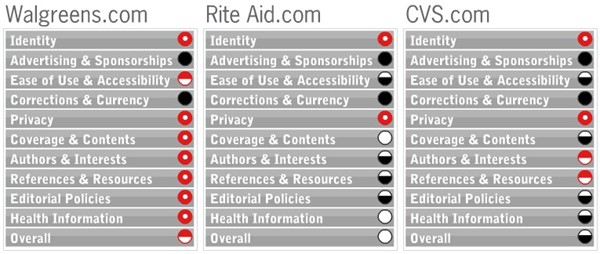
Among the top 3 most-visited online drugstores, Walgreens.com was rated the clear choice for reliable information and ease of use by experts at HealthRatings.org, a joint project of Consumer Reports and the Health Improvement institute.
Walgreens, the most-visited site, received a “very good” rating, while the third most-visited site, RiteAid.com, earned a score of “good” and second most-visited site CVS.com earned a “fair” rating, with raters noting some information-quality concerns.
All sites were rated “excellent” on their privacy policies, an important concern for consumers shopping at online drugstores. Two of the three sites rated only “fair” for ease of use, while Walgreens rated “very good.”
Raters gave all three sites a score of “poor,” however, on disclosure of advertising and sponsorship policies, and on policies for correcting wrong, misleading or outdated information.
Even the best-rated site, Walgreens, contained some information on alternative medicine practices that raters deemed questionable. Another site displayed similarly questionable information, said the raters, about supplements for sale.
“Consumers should think of online drugstores the same way they think of drugstores you walk into,” said Beau Brendler, director of Consumer Reports WebWatch. “You shouldn’t be getting all your health information in the store, where product placement, advertising and other persuasions are at work. You might talk to the pharmacist, you’ve probably done some research, and you’ve probably had a conversation with your doctor.”
Overall, raters did find the three sites to be useful to consumers in enhancing the experience they might have at a walk-in drugstore.
About the study: Using a tool based on WebWatch’s guidelines for website credibility and HII criteria for health information, a panel of health and medical experts examined three sites in-depth over a period of more than one month, then rated each using established Consumer Reports-style methods and the familiar trademarked symbols. The list was determined using Nielsen/NetRatings and WebWatch data. Overall ratings scores were determined from 10 attributes, including identity, advertising and sponsorship disclosure, ease of use, privacy, contents, authorship, references, editorial policies and health information. The raters did not shop at the online drugstores or perform comparison-pricing tests.
Walgreens, the most-visited site, received a “very good” rating, while the third most-visited site, RiteAid.com, earned a score of “good” and second most-visited site CVS.com earned a “fair” rating, with raters noting some information-quality concerns.
All sites were rated “excellent” on their privacy policies, an important concern for consumers shopping at online drugstores. Two of the three sites rated only “fair” for ease of use, while Walgreens rated “very good.”
Raters gave all three sites a score of “poor,” however, on disclosure of advertising and sponsorship policies, and on policies for correcting wrong, misleading or outdated information.
Even the best-rated site, Walgreens, contained some information on alternative medicine practices that raters deemed questionable. Another site displayed similarly questionable information, said the raters, about supplements for sale.
“Consumers should think of online drugstores the same way they think of drugstores you walk into,” said Beau Brendler, director of Consumer Reports WebWatch. “You shouldn’t be getting all your health information in the store, where product placement, advertising and other persuasions are at work. You might talk to the pharmacist, you’ve probably done some research, and you’ve probably had a conversation with your doctor.”
Overall, raters did find the three sites to be useful to consumers in enhancing the experience they might have at a walk-in drugstore.
About the study: Using a tool based on WebWatch’s guidelines for website credibility and HII criteria for health information, a panel of health and medical experts examined three sites in-depth over a period of more than one month, then rated each using established Consumer Reports-style methods and the familiar trademarked symbols. The list was determined using Nielsen/NetRatings and WebWatch data. Overall ratings scores were determined from 10 attributes, including identity, advertising and sponsorship disclosure, ease of use, privacy, contents, authorship, references, editorial policies and health information. The raters did not shop at the online drugstores or perform comparison-pricing tests.
Saturday, August 18, 2007
Elder Care At Home – What Are Your Options?
Many surveys have shown that people prefer to stay in their own homes as long as possible as they age. We should not be surprised. Most of us would rather stay where we are comfortable than move to someplace unknown with new schedules and someone else's rules.
In-home care has come a long way in recent years. Seniors living at home are able to hold on to the feeling of independence while having the help they need with every day life. Being in familiar surroundings can be therapeutic in so many ways. Often the caregivers are family members at first, but before long, a new level of help may be needed. If your loved one needs or soon will need extra help, what are your options?
The decision on the level and frequency of care will often be based on health conditions as well as the realities of daily life. In-home care can be provided on a daily basis, or the caregiver may live-in to provide round-the-clock availability. How well a person is able to handle the "activities of daily living" will be a basic question. Does your loved one need regular help with eating, bathing, dressing, toileting, or transferring? The amount and frequency of assistance needed, plus the need for monitoring medications, will indicate what level of in-home care is best for your loved one.
When you select an elder care service provider, make sure that designate a Care Coordinator who will work with you and create a plan that meets your loved one's needs.
To learn more about elder care services, please visit www.Dubols.com, or call (301) 497-8968 for a complimentary in-home assessment. Dubols is committed to excellence in elder care, for we know that your loved one's health blossoms with tender care.
Article Source: http://www.articlesnatch.com
About the Author:
Yewande D. Awoyemi is the administrator for Dubols Home Care. Dubols is a medical and non-Medical staffing agency that provides caregivers for in home elder care services. www.dubols.com
In-home care has come a long way in recent years. Seniors living at home are able to hold on to the feeling of independence while having the help they need with every day life. Being in familiar surroundings can be therapeutic in so many ways. Often the caregivers are family members at first, but before long, a new level of help may be needed. If your loved one needs or soon will need extra help, what are your options?
The decision on the level and frequency of care will often be based on health conditions as well as the realities of daily life. In-home care can be provided on a daily basis, or the caregiver may live-in to provide round-the-clock availability. How well a person is able to handle the "activities of daily living" will be a basic question. Does your loved one need regular help with eating, bathing, dressing, toileting, or transferring? The amount and frequency of assistance needed, plus the need for monitoring medications, will indicate what level of in-home care is best for your loved one.
When you select an elder care service provider, make sure that designate a Care Coordinator who will work with you and create a plan that meets your loved one's needs.
To learn more about elder care services, please visit www.Dubols.com, or call (301) 497-8968 for a complimentary in-home assessment. Dubols is committed to excellence in elder care, for we know that your loved one's health blossoms with tender care.
Article Source: http://www.articlesnatch.com
About the Author:
Yewande D. Awoyemi is the administrator for Dubols Home Care. Dubols is a medical and non-Medical staffing agency that provides caregivers for in home elder care services. www.dubols.com
Tuesday, August 7, 2007
Are You Drowning in Caregiving?
An area of concern that I get asked about the most is finding someone to give the caregiver a break.Most adult children fall into caregiving as a result of an incident that placed their elder in a crisis situation. After the dust settles and reality sets in often we realize that our lives have changed and this change is often not welcomed.We find ourselves unprepared for caring for our parentespecially when that care is for issues such as dementia, incontinence or immobility. A period of time goes by and then we begin to feel totally overwhelmed. Most of this feeling can be a result of trying to be ALL to our parent. We find that our life, our family, and our routine has gone by the wayside.Many caregivers try to provide care single-handedlywhile neglecting their own needs. It is commonamoung caregivers to think that their life has to comesecond to the needs of their parent. Martyrdom is common.This thinking often leads to frustration, anger and guilt. We forget that we have a right to live and that balance is necessary in everyone's life.There are solutions but they require risk. Many caregivers often fear asking for help because they fear rejection. Admitting that they cannot handle all the caregiving alone is often terrifying. Most wonder why others will not offer to help so they do not have to ask.Picking up the reins is what will help us regain control of our lives. Creating a Freedom Plan1) Get special instruction to provide thecare needed. Ask your doctor for a Medicare Occupational Therapist or a Nurse to instruct you on incontinence care,bathing, a Physical Therapist to teach you how to transfer your parent to the toilet, in/out of the car, set up an exercise routine,etc.2) Make a list of all the things that will give you a break.ex: a cooked meal twice a weeka sitter 9:00am to noon Tuesday and Thursdayplay cards with mom every Wednesday afternoon3) Join a support team even when you think you do not need it. 4) Hire a baby sitter to sit with your parent so you can have a night out with spouse or family night.5) Plan a Vacation by swapping homes with a sibling.6) Hire respite care regularly for you and your family.7) Start all this as soon as possible so your parentgets use to different people providing the care.Keep your needs list current. ANYTIME ANYONE asks if you need anything go right to this list and ask them to choose what ever they feel they can do.You will be amazed how often people will sign up to help when you are clear on your needs.
Article Source: http://www.articlesnatch.com/
About the Author:Alice Endy is a Registered Nurse with advanced certification as a Gerontological Nurse. Alice has helped thousands provide care and support to their elder family members. Alice has been a caregiver for her Mother who is in her twelfth year of Alzheimers Disease. http://www.asknursealice.com/
Article Source: http://www.articlesnatch.com/
About the Author:Alice Endy is a Registered Nurse with advanced certification as a Gerontological Nurse. Alice has helped thousands provide care and support to their elder family members. Alice has been a caregiver for her Mother who is in her twelfth year of Alzheimers Disease. http://www.asknursealice.com/
Subscribe to:
Posts (Atom)